INDEXING & ABSTRACTING
Google Scholar
GARUDA
Crossref
Dimensions
BASE
JOURNAL TEMPLATE

PLAGIARISM CHECKER

Every submitted manuscript will be screened using Turnitin Similarity Check before entering the peer-review process.

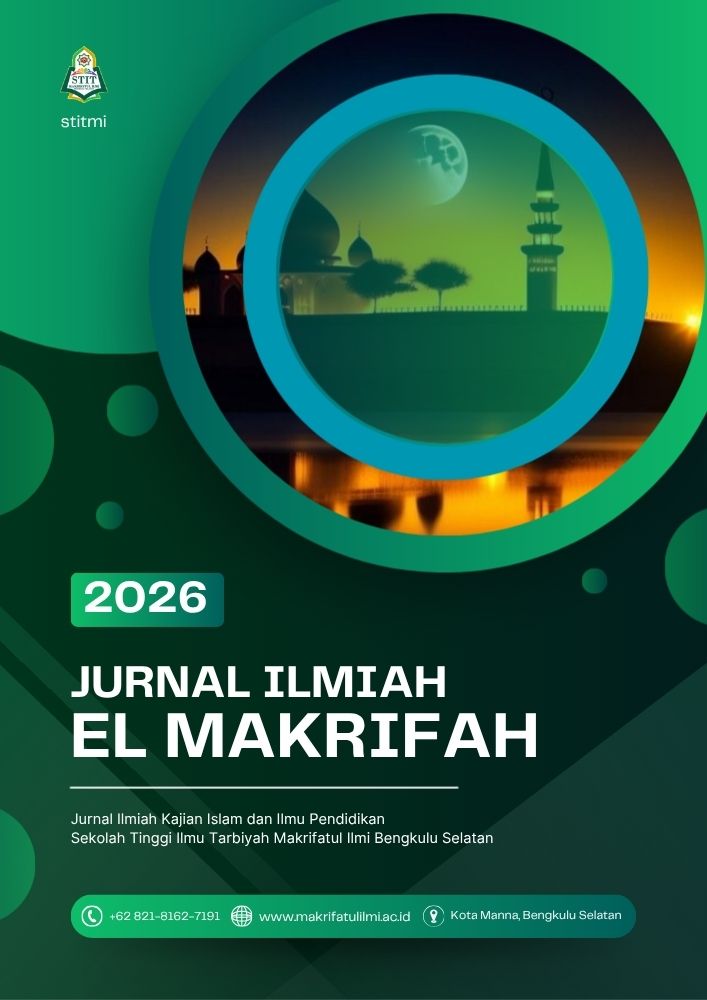
El-Makrifah Journal, Volume 4, Number 1 (2026), features ten scholarly articles on Islamic studies, education, religious moderation, Qur'anic exegesis, Hadith, and the integration of Artificial Intelligence in learning.
The articles highlight interdisciplinary approaches to contemporary issues, demonstrating how Islamic scholarship engages with developments in science, technology, education, and society while preserving its intellectual and ethical foundations.
The Editorial Board thanks the authors, peer reviewers, and editors for their contributions. We hope this issue serves as a valuable academic reference and encourages further research in Islamic studies and education.

El-Makrifah Journal Volume 2, Number 2, 2025 features ten scholarly articles addressing innovations in learning, contemporary Islamic thought, and the promotion of religious moderation. Topics include the role of mosques in community development, implementation of international curricula, reinterpretation of Al-Junayd Al-Baghdadi’s Sufi thought, digital economy fiqh, green AI literacy, integration of Islam and Batak traditions, gamified PAI learning for Generation Z, deep learning in higher education, and thematic “Curriculum of Love” approaches to foster empathy and care in students. This issue aims to enrich academic discourse, strengthen scientific literacy, and support innovative, contextual practices in Islamic education.

The Vol. 2 No. 1 Edition (2025) of the El-Makrifah Journal of Islamic Education and Studies presents scholarly articles focusing on strategic issues in Islamic education and contemporary Islamic thought.
The topics include an evaluation of the Pancasila Student Profile Project, the implementation of the Merdeka Curriculum, and the enhancement of student pedagogical competence. On the other hand, the religious studies section explores Nasr Hamid Abu Zayd’s contextual interpretation of the Qur'an, the revitalization of Islamic values, religious moderation, and critical perspectives on Islamic inheritance law in Indonesia.
This publication integrates critical-reflective, contextual, and interdisciplinary approaches, aiming to strengthen scientific literacy and advance the discourse of moderate Islam in the era of social transformation.


This work is licensed under a Creative Commons Attribution-ShareAlike 4.0 International License .
